![Main Logo - Colorful.svg]](https://help.nomoq.com/hubfs/Main%20Logo%20-%20Colorful.svg)
Part 1: How to Report an Issue
If you encounter any quality, delivery, or artwork issues, please submit your claim as soon as possible by following these steps:
1. Gather Your Information
Before contacting us, make sure you have the following details ready:
- Order Number (e.g. SW-XXXXX)
- A clear description of the problem (e.g., printing defects, damages during transit, seaming issues).
- Batch / Pallet Details: Note which pallet(s) or box(es) are affected.
- Estimated Quantity: How many cans or pallets are impacted by the issue?
- Pasteurization: if cans were pasteurized, please give extra information like method, temperature, time.
2. Take Photo and Video Evidence
Visual evidence is crucial for our Quality Assurance team to fast-track your claim:
- Take high-resolution photos and short videos of the defect.
- Make sure to capture at least one picture of the pallet label, batch number, or packaging markings so we can trace the production run.
3. Book a Service Ticket
We kindly ask you to create a service ticket by filling out our feedback form here
- Should you need to discuss further topics about that claim or need further assistance, please use link below: Book a meeting with our Customer Service
Our Customer Service team will review your report and assign you a Claim ID. They will keep you updated on the investigation or request physical samples if testing is required.
Part 2: Sending Sample Cans
If our team requests that you send sample cans to our plant for quality checks, please package them carefully. Safe shipment ensures our laboratory receives your samples intact for an accurate inspection.
1. Preparing Your Samples
- Prevent Leaks: If sending filled or opened cans, place them in individual sealable plastic bags (e.g., zip-lock).
- Label Clearly: Use a waterproof marker to write your assigned Claim ID directly on each sample can.
- Highlight Defects: If the issue is visual (e.g., printing errors or dents), circle or point to the specific area on the can with a marker.
2. Packing Your Cans
To ensure your samples arrive safely, please follow these guidelines and check the image example below.
-
A. Use a robust Double-Wall Cardboard Box
-
- Avoid weak single-wall boxes: A standard parcel box is not strong enough to support the weight and protect the fragile metal of several cans (especially if filled).
- Opt for heavy-duty cardboard: Always use a sturdy, robust box of double-wall corrugated cardboard. This provides high crushing resistance, protecting the cans from the inevitable shocks during postal or courier transit.
B. Separate the cans using Cardboard Grids/Partitions
- The cans must not come into direct contact with the cardboard box -for example, by using bubble wrap- to prevent damage during transport.
- Prevent metal-to-metal contact: The most common cause of transit damage is cans colliding with each other. Use a cardboard grid/divider system inside your box.
- Create individual cells: Place each can in its own dedicated partition to keep it upright, secure, and isolated from its neighbors.
- Alternative if dividers are unavailable: If you do not have cardboard partition inserts, wrap each individual can tightly in multiple layers of bubble wrap and tightly pack the remaining space with crumpled kraft paper or packing material to prevent any movement.
C. Seal & Mark the outer box
- Add protective cushioning: Add crumpled paper, cardboard, or bubble wrap at the bottom, top and the 4 corners of the box to act as shock absorbers.
- Heavy-duty sealing: Generously apply heavy-duty shipping tape across all seams of the box (especially the bottom and the top flaps).
- Apply Warning Labels: Add "FRAGILE" and "THIS SIDE UP" (↑ ↑) labels visible on at least two sides of the exterior to encourage proper handling by carriers.
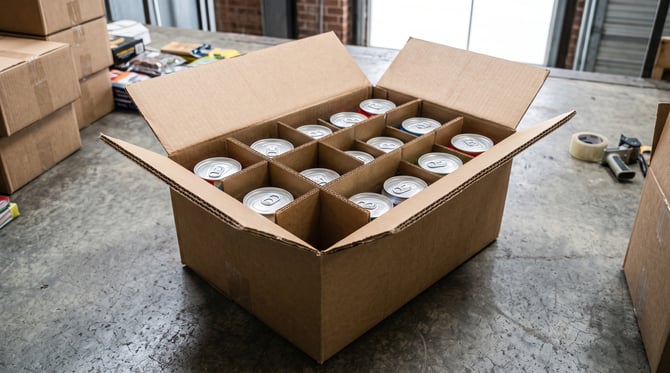
Example of cans in a corrugated carton box
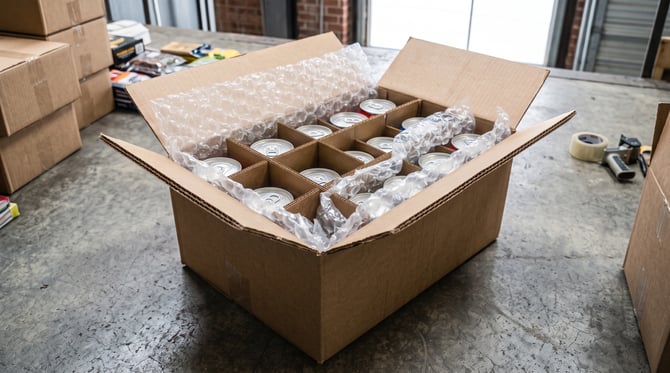
Example of cans in a corrugated carton box with protective cushioning
3. Quick Checks:
- How many samples do I need to send? Usually, a minimum of 6 to 12 representative samples is recommended to allow our lab to conduct proper technical analyses (e.g., cross-sectioning, seaming inspection, or corrosion tests). Please follow the exact quantity requested by your NOMOQ support contact.
- What if I'm sending empty cans vs. filled cans? Both are handled similarly, but filled cans are considerably heavier and carry a high risk of leakage. Always prioritize heavy-duty, double-wall corrugated cardboard, double-seal any opened liquids, and ensure the parcel doesn't exceed courier weight limits.